As Old as the Hills…

via Murmuration

Are you tired of the ceaseless, careless, ignorant murmuration of people with nothing better to do than to create mindless narratives of your life?  Nothing ever changes.  This constant murmuring noise coming from those who feel threatened, and in need of justification for their existence, is as old as the hills.  Literally.  I’ll explain this in a moment.

Grainger Hunt, a senior scientist at the Peregrine Fund tells us that when we marvel at those murmurations in the sky, produced by thousands of starlings as a “dazzling cloud, swirling, pulsating, drawing together to the thinnest of waists, then wildly twisting in pulses of enlargement and diminution,” we may not understand exactly what we are witnessing.  Hunt says these beautiful, sometimes breathtaking murmurations, created by flocks of starlings dancing across the sky, are most often created as a defense mechanism.  These birds are moving as quick as possible in an attempt to put distance between themselves and a nearby falcon. The predator hunting its prey is the cause of this murmuration.  The images of these flocks of gyrating starlings pirouetting through the atmosphere becomes a spiritual metaphor for an ancient problem as old as the hills.

murmuration

Do you remember the first murmur?  Genesis 3:1 “Now the serpent was the most cunning of all the wild animals that the LORD God had made. He said to the woman, “Did God really say, ‘You can’t eat from any tree in the garden?

Do you remember the second murmur? Genesis 3:12  Then the man replied, “The woman You gave to be with me–she gave me some fruit from the tree, and I ate.”

When God said “What is this you have done?” (verse 13), you realize of course this was a rhetorical question.  The clear teaching of scripture is that God is eternal, and omniscient.  Simply put, God has all knowledge of all things at all times.  So God isn’t quizzing them so that HE could understand or have information He did not previously know.  God is making a point of bringing clarity to the gravity of their choices to murmur, hedge, and make themselves look good.  Satan felt threatened by God so he chose to seduce and entice Eve with murmurations.  Eve, once having tasted the forbidden fruit, preyed upon by her own conscience, didn’t want to be alone in the mischief and used Satan’s words to bring Adam along.  Adam, not wanting full blame for the disobedience, spews murmurations about “that woman.”  The threat of being caught makes the flock twist and turn in shock and bewilderment.

It’s an ancient problem.  Seen in the first century images of the New Testament, the Jewish leaders continually felt threatened when the large crowds began to follow this itinerant teacher from Nazareth.  They were so intimidated by His authority they began to bully and berate Jesus at every turn, seeking to lay a trap to have Him killed.  Their murmurations are clearly seen as a strong defense mechanism attempting to escape what they all knew would be coming their way.  Judgment.

Those who know me, also know, one of my past pet phrases was “It is what it is.”  Murmurations are what they are.  Whether visually seen in the starling dance, or spiritually seen in blinding light of God’s word, the problem of murmurs will never go away.  People who feel threatened murmur.  If enough people share the same views, the gathering crowds create murmurations seen clearly from several miles away. From two thousand years past we can still hear the murmuration of the shouting crowd, “Crucify Him! Crucify Him!”  In fact, God in heaven can see them now, and He knows who started it, and why.

What do you do when you feel threatened?  Do you dance like a puppet on a string, trying your best to put yourself in a good light?  Do you sway and dip, compromising your faith, because someone rose up against you in the dark?  When the murmurations of the world rise up against you, in evil menacing shapes, remember the words of Paul.

1 Corinthians 16:13
Be alert, stand firm in the faith, act like a man, be strong.

No murmurations, just faith.  Faith that God will see you through whatever situation or circumstance is seeking to devour you.

Eden’s Design

via Pattern

Having a vivid imagination has it’s drawbacks. While I have imagined the Garden of Eden many times, it seems to shift and evolve each time into something indefinable.  In this way it is rather like heaven somewhere out there in the future, but the definitions are so vague it allows only expectation without perfect knowledge of the details. We can’t go back to Eden, God has secured it’s location. We have to vacate our current human housing to go to heaven, which scares us silly to think about.  What a dilemma.  Stuck in an imperfect world, with imperfect people, living imperfect lives.  Was this really the Creator’s design? No.

Tapestries are like that though.  From the backside of the tapestry one can see brightly colored threads woven in among the darker ones, colliding and cascading together in what seems on first observation to have no rhyme or reason.  It is only when looking face on to the front of the tapestry that we can understand the weaver’s intentions and design.  The pattern becomes strikingly obvious, and we have one of those “aha” moments.

I look back on the tapestry of my life so far, and I understand this only partially.  What seemed like chaos at times, living through the struggles, fears and insecurities of difficult days or events or circumstances, in one sense has order today in the view from the “other side.”  My life took on a pattern of God’s own design, weaving all those feelings, pains, struggles, joys, victories, and experiences into the person I am right this minute.  It was for His glory, not mine.  He is the Master Weaver.

Eden was the origination point for the human experience, according to the Bible.  Yet, man’s struggle with staying in the boundaries of the design, and the simple demands of the Creator, resulted in being cast into a world filled with chaos.  Even in this event God would show grace and mercy, and point to a pattern far into the future, when He would go to extravagant lengths to save the people who would trust Him.  In examining heaven’s description in Revelation, we see a look back at the design pattern for Eden.

The Master Weaver also has designs for your life you may not even recognize or know of today.  The chaos surrounding you may be deafening, or so painful you wonder if you will even come out the other side.  It’s a moment or a series of moments that every person faces at some time in their life, when they have to choose between believing there is some design, or hopelessly resigning to believe there is only chaos.  At these times it’s best if we stop and try to examine not the chaos side, but the other side of the tapestry of our lives to find the meaning of what has happened in the past.  If the Master Weaver can help us see the design so far… it becomes easier to believe there is pattern and purpose going forward. It helps us trust the Weaver to weave into our life what is best for us.

Paul says it this way in Ephesians 3:20-21…

Now to Him who is able to do above and beyond all that we ask or think according to the power that works in us–to Him be glory in the church and in Christ Jesus to all generations, forever and ever. Amen.

God at work


Eyes and Minds

via Abstract

Up is down, left is right, right is wrong, and that baby is just ugly.  These are examples of things you don’t say out loud, unless you want some serious retribution from those who think you’re a couple of tacos short of the house special.  Theoretical concepts are sometimes the hardest to communicate, in that they are, well, theories until proven true in a physical or concrete experiment, or evidence.  A light saber in the hands of the Jedi is apparently just as efficient a weapon as a laser rifle in the hands of the Alliance minions.  It’s true, but only in the metaphysical sense of the mind, since neither exists in our reality today.

Moving from the abstract to the real, in the spiritual world, doesn’t have to be a mystical experience.  However, it cannot be limited to the academic either.  Extracting anything from the Bible that is useful for living daily in the 21st century requires open spiritual minds and open spiritual eyes.  Then the problem is, how does the “opening” occur?  Paul gives us the solution.

1 Corinthians 2:10-15
Now God has revealed these things to us by the Spirit, for the Spirit searches everything, even the depths of God. For who among men knows the thoughts of a man except the spirit of the man that is in him? In the same way, no one knows the thoughts of God except the Spirit of God.Now we have not received the spirit of the world, but the Spirit who comes from God, so that we may understand what has been freely given to us by God. We also speak these things, not in words taught by human wisdom, but in those taught by the Spirit, explaining spiritual things to spiritual people. But the unbeliever does not welcome what comes from God’s Spirit, because it is foolishness to him; he is not able to understand it since it is evaluated spiritually.  The spiritual person, however, can evaluate everything, yet he himself cannot be evaluated by anyone.

To the unbelieving, spiritually blind in this world, none of the things of God are revealed or understood.  The Revelation of God belongs to those who have stepped over the line of faith into Jesus. Simplistic?  Sure.  Hard to believe? Absolutely.  Still true? Yep.

Whether we ever recognize spiritual truth or not, is largely determined by our seeker-of-truth life choices.  Do we really want to know truth? Or, do we pretend to want to have this knowledge so we can “fit in” with those around us seeking truth?  I suggest that T. E. Lawrence was just such an individual – seeking truth.  He said, “All men dream: but not equally.  Those who dream by night in the dusty recesses of their minds wake in the day to find that it was vanity; but the dreamers of the day are dangerous men, for they may act their dreams with open eyes, to make it possible.”  Lawrence in my opinion was a truth-seeker.

Stephen Hawking is another truth-seeker.  Hawking said, “Remember to look up at the stars and not down at your feet.  Try to make sense of what you see and wonder about what makes the universe exist.  Be curious.  And however difficult life may seem, there is always something you can do and succeed at.  It matters that you don’t just give up.

Seeking truth requires a specific action/choice.  In order to “see” a person has to realize they are “blind” and in need of “sight.”  The blind, roaring at the top of the lungs that they see better than anyone else, is a laughable sight to those who really see.  We don’t laugh though, we mourn.  We would have everyone come to the knowledge of truth.  We wish that all men, women, boys and girls around the globe could finally see the truth.

Jesus said, “I am the way, THE TRUTH, and the life; and no one comes to the Father but through me.”  [John 14:6]

abstract


stephen-hawking


7-5x9-25-front-cover-final

50 Shades of Truth

via Nuance

nuance

The now famous quote of Alan Greenspan is the perfect example of nuance in spoken communications.  “I know you think you understand what you thought I said, but I’m not sure you realize that what you heard is not what I meant.”  For those not familiar with Alan Greenspan, he is an economist who from 1987 to 2006 was chairman of the Board of Governors of the Federal Reserve of the United States. Now he works in the private sector giving advice, making speeches, and consulting through Greenspan Associates LLC.

The subtle differences in inferences, implications, insinuations, intimations, and indications also speak of the nuances of our English language.  When someone says, “Just say what you mean,” it is a request for honest, truthful verbal expression of state of mind or intention.  But “meaning what you say” is about that person matching their subsequent behavior or action in ways that are consistent with what was said.  Nuance.

Robert K. Merton is credited with naming and popularizing the “law of unintended consequences.”  He says we act, determined to accomplish certain purposes, but there are often results that we did not anticipate that happen as well – unintended consequences. Nuance in our speech often has this same net effect or result. When we look for biblical models, we don’t have to look very far.

In the eighth chapter of John, after Jesus forgives an adulterous woman, John records a lengthly conversation about truth and freedom.  In the crowd that had gathered, there were those who believed in Him.  So Jesus said to these believing Jews, “If you continue in My word, you really are My disciples.  You will know the truth, and the truth will set you free.”  Which was immediately perceived as a poke at their Roman servitude. So the crowd responds, “We are descendants of Abraham, and we have never been enslaved to anyone.  How can you say, ‘You will become free.’” Clearly these men needed another history lesson of the Hebrew people.

Here comes the nuance of the conversation: Jesus was speaking of spiritual truth, and they were hearing in literal worldview terminology.  The consequence: while the word “believe” in verse 30 might imply “faith,” the nature and context of the dialogue insists “believe” is better translated “intellectual understanding” not saving faith.  This becomes crystal clear in the ensuing conversation.

Jesus responded, “I assure you: Everyone who commits sin is a slave of sin.  A slave does not remain in the household forever, but a son does remain forever.Therefore, if the Son sets you free, you really will be free.  I know you are descendants of Abraham, but you are trying to kill Me because My word is not welcome among you. I speak what I have seen in the presence of the Father; therefore, you do what you have heard from your father.

They replied, “Our father is Abraham!

Jesus told them, “If you were Abraham’s children, you would do what Abraham did. But now you are trying to kill Me, a man who has told you the truth that I heard from God. Abraham did not do this!  You’re doing what your father does.

They replied, “We have one Father – God.

Jesus said to them, “If God were your Father, you would love Me, because I came from God and I am here. For I didn’t come on My own, but He sent Me. Why don’t you understand what I say? Because you cannot listen to My word. You are of your father the Devil, and you want to carry out your father’s desires. He was a murderer from the beginning and has not stood in the truth, because there is no truth in him. When he tells a lie, he speaks from his own nature, because he is a liar and the father of liars.Yet because I tell the truth, you do not believe Me. Who among you can convict Me of sin? If I tell the truth, why don’t you believe Me? The one who is from God listens to God’s words. This is why you don’t listen, because you are not from God.

At the end of this conversation, John says they picked up stones to throw at Him.
[John 8:30-59]

How does this apply today?  The subtle shift in spiritual thinking today is found when liberal theologians, pastors, and bible teachers compromise the Word of God by twisting the words to imply or insinuate something God would never say.  The Bible speaks literally regarding truth, it doesn’t have 50 shades of truth.  It is a guidebook and an answer book for those who seek truth.  Those who seek to rationalize their behavior, actions or words, will always find a way like these Pharisees, to argue with God Himself about what truth is.  Most of the time, those who do this are thinking with worldly minds instead of transformed spiritual minds.  That’s why the apostle Paul gave these instructions:

Romans 12:2
Do not be conformed to this age, but be transformed by the renewing of your mind, so that you may discern what is the good, pleasing, and perfect will of God.

The truth is the truth.  There is no nuance with truth.

Chillax already!

via Nervous

brain gears

What makes you nervous?  Not having a plan?  Not confident of your plan?  Constantly thinking about what other people think about your plan?  Worrying that they won’t appreciate or go along with your plan?

Or maybe you’re just the high-strung, anxious, excitable type, jumping at loud noises, and screaming when someone sneaks up on you.  My uncle Wylie used to call someone like this a “nervous Nellie.”  Being a little skittish or neurotic isn’t a bad thing, it could be caused by any number of things.  Getting worked up and overwrought about things we can control is one thing, but getting stressed out and agitated about things beyond our control… well, at that point in order to “chillax,” a person needs a strong faith.

I’m not talking about faith in karma, or some existential or pollyanna type faith.  I’m talking about a foundational belief system based in evidence and experience, to which a person turns when life around them seems to be falling apart.  When the unthinkable happens and the unimaginable results.  What then?  What kind of faith handles this part of life, helping us not fall apart at the seams of our being?

Hebrews 11:1-3
Now faith is the assurance of things hoped for, the conviction of things not seen.  For by it the men of old gained approval.  By faith we understand that the worlds were prepared by the word of God, so that what is seen was not made out of things which are visible.

Faith is not just a girl’s name.  Faith is not just some ethereal ideal, or sophomoric whim.  Faith is choosing to believe that the world we live in was prepared for us by the Creator, who then instituted life in all forms, including ours.  The Bible says this is what the “ancients” believed when they looked up into the night sky, blazing with a million tiny lights.  The “ancients” believed the Creator formed all the plants and the animals, and ultimately created human life.  The “ancients” believed that this Creator of all things didn’t just create and then abandon His creation to fend for themselves in a hostile environment.  Rather, they believed that the Creator, once finished with the creative process, went about the business of revealing Himself to the human creature in ways that constituted a relationship.

In this personal relationship, the primary revelation God wanted humans to hear was, “do not be afraid.”  While God spoke to and through these “ancients” to reveal Himself, more recently in the “near” ancient time, God has revealed Himself through His Son.

Hebrews 1:1-4
God, after He spoke long ago to the fathers in the prophets in many portions and in many ways, in these last days has spoken to us in His Son, whom He appointed heir of all things, through whom also He made the world. And He is the radiance of His glory and the exact representation of His nature, and upholds all things by the word of His power. When He had made purification of sins, He sat down at the right hand of the Majesty on high, having become as much better than the angels, as He has inherited a more excellent name than they.

In fact, He has spoken of how all things will ultimately be wrapped up and put right when Jesus, the Son of God, returns a second time.  You can read and study all about that if you click here.

For the nervous Nellie, for the strung-out, the over-excited, the skittish or neurotic, who believe the world is on a mission to self-destruct, and there is no hope…  God says, “Chillax, I got this.”


Man, I’m glad I’m not a cow!

via Ruminate

cow

You might need to chew on that title for awhile, while you mull over what I meant by it.  My good buddy, Dr. John Scott Herrington, made this statement (the title) while we were on a trip as he looked out over a field where a herd of cows were grazing.  It was hysterical at the time, but I guess you had to be there.  It got me thinking though.  As cows stand there in the field, chewing their cud, they give the false impression of being deep thinkers. They have this goofy look on their face, as their jaws just chew and chew.  When in reality, we all know cows aren’t the brightest animals on the farm.

Looks can be deceiving.  I agreed with my good friend, that indeed, it would be better to be a human than a cow.  But why?  Where is God more glorified?  Is God more glorified in a creature made with two stomachs, and any time the creature wants to can just cough up a cud of food to ruminate on again?  Or is God more glorified in a higher thinking creature who constantly argues with the Creator about what is best for them in life?  Hmmmm.  It’s a puzzle right?

It also made me think of animals in general, and birds in particular.  Sparrows, in fact, came to mind as I pondered what I might learn from this simple observation.  This took me to a story some may remember from Sunday school, where Jesus was teaching His student followers the principles of discipleship.  Specifically Jesus was helping them understand the cure for anxiety.  Why would Jesus need to teach his disciples this lesson?  Because what human creatures do is argue with the Creator about what’s best for them in life, and when they don’t get the answer they want, they tend to worry and become anxious.  The disciples suffered from this malady just as the rest of us do.

Matthew 10:29-31
Are not two sparrows sold for a cent? And yet not one of them will fall to the ground apart from your Father. But the very hairs of your head are all numbered. So do not fear; you are more valuable than many sparrows.

Matthew 6:25-27
For this reason I say to you, do not be worried about your life, as to what you will eat or what you will drink; nor for your body, as to what you will put on. Is not life more than food, and the body more than clothing? Look at the birds of the air, that they do not sow, nor reap nor gather into barns, and yet your heavenly Father feeds them. Are you not worth much more than they? And who of you by being worried can add a single hour to his life?

We do well to realize that Jesus speaks directly to us today in these commands.  Do you see the specific commands here?  “So do not fear… do not be worried about your life.”  Well, that’s easy to do right?  Humans seem to have this innate capability to pretend they are cows.  We spiritually and emotionally cough up into our hearts and minds those things we like to worry about or anxiously try to fix about our lives.  We ruminate over and over about the “what-ifs” of life, trying to work out a response to every possible permutation, never comprehending that we aren’t wired for this knowledge.  Only God knows every possible permutation, and He has each of them covered.

Jesus says lilies in the field give God more glory than people do sometime.

Matthew 6:28-33
And why are you worried about clothing?  Observe how the lilies of the field grow; they do not toil nor do they spin, yet I say to you that not even Solomon in all his glory clothed himself like one of these.  But if God so clothes the grass of the field, which is alive today and tomorrow is thrown into the furnace, will He not much more clothe you?  You of little faith!  Do not worry then, saying, ‘What will we eat?’ or ‘What will we drink?’ or ‘What will we wear for clothing?’  For the Gentiles eagerly seek all these things; for your heavenly Father knows that you need all these things.  But seek first His kingdom and His righteousness, and all these things will be added to you.

Humans were created to think on a level far above flowers, birds, and cows.  We are capable of recognizing just how much God loves us on a personal level, and how He engineered a way for us to be in relationship with Him personally.  God gave us the highest thinking brain available among all the species of the planet.  Yet, we abuse this great gift by ruminating about ourselves, rather than contemplating how better to walk with God and bring Him glory.

I’m glad I’m not a cow, a bird, or a flower.  However, I want to come to the place where I, as God’s highest creation, bring Him greater glory than all the animals or vegetation of the planet.  They do so by instinct.  I bring Him greater glory when I choose to trust in His provision and direction, and live for Him instead of myself.  Verse 33 speaks for itself.


Trendy

via Swarm

What we called “fads” when I was growing up (think bell-bottom jeans, chia pets, and disco dancing), are more likely today called trends.  However, it might just as easily be called “mob mentality” as people swarm to what’s hot at the moment.  Some easy examples might be: the stock market, fashion apparel, automobiles, music, and yes… religion.  Let me be clear.  I said religion, not Christianity.  Not many people today rush to join the movement of TRUE Christianity.

world-religions

Pundits like to lump all faith models together in a box, and call them “religion,” and in so doing deny there is ever really any difference in any of them.  Whether it’s Islam, Baha’i, Hinduism, Buddhism, Confucianism, Taoism, Sikhism, Unitarianism, Jainism, Zoroastrianism, Native Spirituality, Judaism, … or Christianity… pundits say they are all the same.  They say it’s a swarm mentality that draws us to these flames.  I contend that the religions of the world have only one thing in common.  Humans are created with an awareness of God, and have tried since the world began to worship the Creator, but in twisted man-invented ways.  Humans in their core DNA are hard-wired to worship something, or someone, so in the absence of wealth, fashion, cars, and music… they create deities of their own design.

Within the construct of each world-religious system, there are variations and themes which spread their influence in thousands of different directions.  Following the trends of ancient peoples, in the 21st century it is often “fashionable” (I call it swarmy) to announce your inclusion into one of the “newer” or “more ancient” religious systems like Scientology (newer) or Satanism (ancient).  People swarm to a widely-shared but short-lived enthusiasm for something new.  Until the next “new” thing comes along.  Or until the fallacy of the bandwagon they hopped onto fails to satisfy their need for new.

Two thousand years ago, Jesus had thousands of followers swarming into every tiny village and town He wandered through.  They all sought to catch a glimpse of the miracle-working carpenter who taught the Torah and read the Prophets with authority.  The swarming, teeming crowds became so strong at one point that He had to get into a boat and push off shore just a bit to keep from getting trampled under foot. [Matthew 13:2]  Most of the crowds from His first year had abandoned Him by the third year, and were no where to be found in the end.  Thousands cheered and celebrated as He entered Jerusalem on Sunday before Passover.  Thousands yelled and cursed Him, as He carried His own cross through the streets to Golgotha.  Do you see the “swarm” mentality in this historically accurate narrative?

It takes more commitment than a “fad” mentality to be in relationship with the Creator of the universe.  Jesus told one woman, “But an hour is coming, and is now here, when the true worshipers will worship the Father in spirit and truth.  Yes, the Father wants such people to worship Him.  God is spirit, and those who worship Him must worship in spirit and truth.” [John 4:23-24]  These words apply today, at least as much as when they were spoken, perhaps even more.  Combine this thought with what Jesus said that night he was arrested, “I am the way, the truth, and the life; no one comes to the Father but through Me.” [John 14:6]

These two foundational truths compel us to seek more than a fad, more than a trendy spiritual answer.  We find it only in the ultimate reality of Jesus’ words to one of the Jewish leaders named Nicodemus.  John 3:16 “For God loved the world in this way: He gave His One and ONLY Son, so that everyone who believes in Him will not perish but have eternal life.”   Jesus died for the swarming mass of humanity.  When Jesus said “everyone,” everyone means me.  Everyone means you.  It requires more than just being part of the swarm.  Stepping over the line of faith, and believing these three verses, receiving the grace offered in Christ, is a personal commitment.  It is how a person fulfills their created purpose.  Living in this grace and extending God’s glory, is what true worship means.  It requires more than just being part of the swarm.

Through the Looking Glass

via Vivid

On days like today, I like to imagine I’m back in Breckenridge, Colorado.  It’s August and we’ve just arrived.  My first look up and out at the majesty of the mountains motivates me to try to capture the image.  However, raising my camera, I was accosted by something much closer to where I actually stood.  The beauty arrayed in the vivid colors of this flower pot became the metaphor for my whole life.

breck-5

We do this don’t we?  We look way out there in the distance of life, planning our future, dreaming of what may come, or when we might reach a desired destination.  All the while life is happening all around us, bright, graphic, authentic, detailed, and picturesque.  We miss it if we don’t refocus our lens, and capture the now, instead of the distant “when.”

I remember a phrase I heard frequently growing up, “He’s so heavenly minded, he’s of no earthly good.”  It’s an easy trap, and I’ve been it’s victim all too often I fear.  Just as in our earthly lives we plan and prod along on a path to something desirable, at times it seems our spiritual lives are so caught up in “heaven someday soon” that living in the light and beauty of God’s presence right here, right now is totally out of focus.  The grass may indeed be greener over there, but what God want’s us to see in this moment, is the scintillating glow of the flower pot in front of us.

The very reason the disciples missed so much of the message Jesus tried to help them with was that their focus continually was on His establishment of an earthly kingdom.  They kept asking, “is it now?”  They fought over who would be the greatest in the Master’s court.  All the while, they missed the elegant and eloquent display of grandeur that is the glory of God in Christ.  In fact except that Jesus forced them to see it, they would have missed it completely.  So, Jesus arranges a road-trip up the high mountain where He is transfigured before them.  His face was shining like the sun.  His clothes were as translucent as light.  They saw him carrying on a dialogue with Moses and Elijah.  They would have missed it completely, if Jesus hadn’t insisted that they come. [Matthew 17:1-13]

Looking out my office window as I write these words, the sky is overcast, giving a dull and dreary outlook for a Sunday morning.  Closer still in my vision is my study Bible, with florescent tabs sticking out.  The vivid contrast of the bright tabs against the darkened hazy sky helps me focus.  I will not be forever bound to this office, looking out into a world filled with darkness.  One day I will rest in the heavenly places as a child of the King.  Until then, my job is to continue writing, and telling of God’s wonderful grace, and experience that grace myself every single day.  My job is to do what I can right here, right now, to bring God great glory with what is left of my time here on earth.   I don’t want to miss the flower pot here simply because I’m so caught up with how majestic and glorious it will be there.

Let your light shine before men in such a way that they may see your good works, and glorify your Father who is in heaven.  ~ Matthew 5:16


Pie in the Sky

via Parlay

I’ve been to Vegas, I know it can happen.  Find someone to stake you, if you can’t stake yourself, and turn the stake into something greater than the sum of a few bets.  I’ve even seen it happen. To a few.  A very happy few, and that in itself is sad.  Because the fact remains that in Vegas, only the few ever beat the house and win big.  Vegas loves the parlay.  They want to take you stake, your winnings, and invite you to parlay.  The odds are never in your favor.  That’s why they call it “beating the odds.”

poker

What are the odds, that every day as I write these short vignettes, as I try my hand at profundity and insight, that I’m right in my observations about God’s sovereign authority over all?  I’d say about the odds are 50-50 wouldn’t you?   I mean, either I’m right, or I’m wrong. Yes? So for argument’s sake, let’s assume for a moment that I’m wrong.  If I’m wrong then everyone who reads these words can just see them as entertainment.  The musings of a mad man bent on proclaiming a gospel that is nothing more than myth.  If I’m wrong then Jesus isn’t the savior, the Holy Spirit doesn’t lead and guide us, and God doesn’t exist.

What are the odds?  50-50.

If I’m right however, if God not only exists but is the Creator of all things; if the Holy Spirit leads us to salvation, then on to relationship with the Creator; if Jesus is God and Savior as the Bible proclaims – then these short articles of faith have eternal value and truth. Then heaven is real and so is that other place no one likes to talk about.  We can’t both be right, so the odds for each of us is 50-50.

What are the stakes?

The annihilation view is one of finality at death.  Those who hold this view think when this human life ceases, it’s just over, there is nothing left of body, soul, or spirit.  We are annihilated.  Right or wrong?  50-50.  All atheists are essentially of this order.  Many people live this way, by not making a conscious choice to explore biblical truth.

The “all dog’s go to heaven” view is one of eternal optimism.   Those who hold this view are convinced if there is a heaven, all us “dogs” are going to get there eventually.  It’s just a matter of time.  Most people you pass on the street, believe this in one form or another.  Organized world religions have fostered this mentality, setting out to prove if you just follow their prescription, you too will arrive in Muhammed’s Paradise, Hebrew Paradise, the Good Kingdom, Tian, Purgatory, or Heaven.  Right or wrong?  50-50.

The Biblical view is the option I prefer to believe.  It is a choice I make consciously.  It is mine alone to make.  Just as you will choose while reading this, which to believe.  The difference in the Biblical view and all other world religions is seen in the prescription for true faith, and the requirements for entrance into heaven.  True faith relies not on any act or work I perform to gain entrance to heaven.  True faith isn’t bent on a set of legalistic rules to follow.  True faith that saves, according to the Bible, is yielding my will to God’s will, and trusting Jesus as my personal Messiah, Savior, Redeemer, Deliverer.  Upon stepping over this line of faith, (my will for His will), I become a member of God’s family.  I am given an inheritance.  One which will not see corruption from moths and rust.  An inheritance guaranteed by God’s Holy Spirit.  And one day… according to the Bible… I will live with my Creator, Father, God – forever.  Right or wrong?  50-50.

Parlay…

Blaise Pascal’s wager simply says it would be wise to live your life as if God does exist because you have everything to gain and nothing to lose.  If you live this way, and God does exist, you gain heaven; if God doesn’t exist, you lose nothing.  On the other hand, if you live as though God does not exist, and He doesn’t, you lose nothing.  But if God does exist, and you live as though He doesn’t, you’ve gained hell and punishment, and have lost heaven and bliss.

I’m not one of those pie-in-the-sky-by-and-by people.  I actually live more for the “right now,” and hope to gain heaven because I have faith in Jesus.  But the real point is: What do you base your life on today, that will have any eternal value?  I do choose Pascal’s wager as true.  I live as though God exists, that He loves me, and has a future for me here, and after here.  I’m betting the parlay, that God has more … much, much more in store for me there. So I live as though it is true… here.


I got a powerful hankerin’…

via Daily Prompt: Desire

“… for some steak and taters! What did you think I was gonna say?  Get your mind out of the gutter boy, your crowdin’ me.” Or so my uncle Wylie used to say.  I saw a couple of good quotes today regarding: desire.

My purpose in life does not include a hankering to charm society.” ~ James Dean

Hankering after material happiness is called lust & such activities are sure to meet with frustration in the long run.” ~ author unknown

For years, I’ve had a hankering for the portrait of Benjamin Franklin by Joseph Duplessis.  Franklin is credited with so many inventions: the postal system, lightening rods, the constitution.  He was a rock star before there was such a thing.” ~ Jon Bon Jovi

Everyone has strong desires. Strong desires make us feel alive.  Granted, some people are so driven by their desires that the lusting, craving, longing, aching, passionate search for fulfilling these desires leads to destructive behavior and meaningless or broken relationships.  Such is the nature of desire gone amuck.

It seems some easily justify this powerful hankerin’, as they quote the Bible out of context, simply to bring affirmation to their licentious lifestyle.  Imagine God’s anger when folks twist and pervert David’s words from Psalm 37, to fit their own agenda.

Psalm 37:4 “Delight yourself in the LORD; and He will give you the desires of your heart.”

The masquerading hypocrite who uses God’s word to authenticate a “worldly” lifestyle knows nothing of God’s will or ways.  They only see the second part of this verse while ignoring the meaning of “delight yourself in the LORD.”  If we delight in God’s will, His Holy Spirit transforms our human “hankerings” to align with His purposes.  Only when this transformation has taken place can a person “in God’s will” ask, and the desire will be met.  Only because, it was God’s delight first, and these “desires” brings Him glory.

If you need some help with what mis-aligned desires look like, turn to John’s first letter for the details.  God’s Word is pretty specific here:

1 John 2:16 “For all that is in the world, the lust of the flesh and the lust of the eyes and the boastful pride of life, is not from the Father, but is from the world.”

Lust of the flesh = material wealth or goods
Lust of the eyes = human sensuality (all five senses)
Pride of Life = achievement, power, fame

When these hankerings get the best of us, we are definitely not delighting in God, but in ourselves.  We are completely out of balance with what God intended our lives to be.  The pull and power of these three areas (flesh, eyes, pride) is completely destructive.

Now for the positive side of hankerin’.

Don’t miss the more exciting truth of Psalm 37:4… “He will give you the desires of your heart, (when you) delight yourself in the LORD.”  A person of faith knows that God wants only what’s best for them.  This knowledge gives foundation for leaping joyfully, and shouting mightily, telling of the great things God is at work doing in their life.  The person of faith is busy every day discovering and experiencing God’s grace.  This daily experience brings confident living, which shines like a beacon to those walking in darkness.

I have a powerful hankerin’ to be this kind of light … in a very dark world.

Psalm 42:1
As a deer longs for streams of water, so I long for You, God.

Neo to Morpheus

via Doubt

The mind bending alternate universe of The Matrix has always intrigued me.  Great movies like these sometimes challenge us to question everything we believe.  Is the keyboard I’m typing on real, or just an illusion?  Morpheus says to Neo, “I’m trying to free your mind, Neo.  But I can only show you the door.  You’re the one that has to walk through it.

matrix

Life for people of faith is exactly like this.  Doubt is a part of our existence, and Jesus knew this.  This knowledge is what originated the final part of the plan, whereby God’s Holy Spirit would indwell those who have stepped over the line of FAITH into Christ.  It’s as though Jesus says to every new believer, “I’m trying to free your mind.  But I can only show you the door.  You’re the one that has to walk through it.”  When God’s Spirit leads us, we follow.  When God’s Spirit inspires us, we write or speak.  When God’s Spirit motivates us, we act in ways that benefit others and bring glory to God.  That’s what it means to walk in the Spirit.  We live out our existence in this world, believing that there is another unseen world more real than the one we inhabit.

Paul said, “For we walk by faith, not by sight-”  2 Corinthians 5:7

However, consider a few other verses which shed light on our doubt.

Proverbs 28:26
He who trusts in his own heart is a fool, But he who walks wisely will be delivered.

Psalms 25:4
Show me your ways, LORD, teach me your paths.

James 1:6
But let him ask in faith without doubting. For the doubter is like the surging sea, driven and tossed by the wind.

Jesus was constantly asking those 12 men who followed him most closely, “Why did you doubt?”  Yet, remarkable as it may seem, Jesus fully anticipated that not only they, but we too would live a life filled with doubt.  So Jesus said to them, and to us, “Do not let your heart be troubled; believe in God, believe also in Me.” John 14:1

There are days when I feel more like the man who watched his son, writhing on the ground, foaming at the mouth, at the mercy of a demon attacking the boy. The man just wants his boy to be free and sane again.  Follow this conversation… Mark 9:14-29

Jesus: “How long has this been happening to him?
Dad: “From childhood. It has often thrown him both into the fire and into the water to destroy him. But if You can do anything, take pity on us and help us!

Jesus: “IF … You can?  All things are possible to him who believes.
Dad: “I DO … believe!! Help my unbelief!

Many times in my past, in my present, and I expect in my future, I have or will look to heaven and cry out… “help my unbelief!”  Why?  Because I can’t see the Matrix that is God’s perfect will.   Because not only can I not see the Matrix, I can’t sometimes make sense even out of what I do see.  It causes me to doubt.  Not in a vacillating way trying to decide if I still believe it all.  But in a much deeper way than mere words can describe.  I’m like this dad… I just want help.

The Holy Spirit often speaks to me in moments like these with these words of wisdom…

Isaiah 64:4
For from days of old they have not heard or perceived by ear, Nor has the eye seen a God besides You, Who acts in behalf of the one who waits for Him.

Paul quoted this exact passage when he wrote to the Corinthians (1 Corinthians 2:9-12):

but just as it is written,
            “THINGS WHICH EYE HAS NOT SEEN AND EAR HAS NOT HEARD,
            AND which HAVE NOT ENTERED THE HEART OF MAN,
            ALL THAT GOD HAS PREPARED FOR THOSE WHO LOVE HIM.”

For to us God revealed them through the Spirit; for the Spirit searches all things, even the depths of God. For who among men knows the thoughts of a man except the spirit of the man which is in him? Even so the thoughts of God no one knows except the Spirit of God. Now we have received, not the spirit of the world, but the Spirit who is from God, so that we may know the things freely given to us by God.

Seeing is not believing.  Believing is seeing.  Do not doubt.  Do not be afraid.  Open the door to God’s Holy Spirit.

Jesus says:  I got this.

He who hesitates…

via Hesitate

hesitation

T. S. Eliot wrote:
We do not know very much of the future
Except that from generation to generation
The same things happen again and again
Men learn little from other’s experience.

2 Corinthians 6:2
… for He says, “At the acceptable time I listened to you, and on the day of salvation I helped you.”  Behold, now is “the Acceptable time,” behold, now is “the Day of Salvation” —

Hebrews 4:7
He again fixes a certain day, “Today,” saying through David after so long a time just as has been said before, “Today if you hear His voice, do not harden your hearts.”

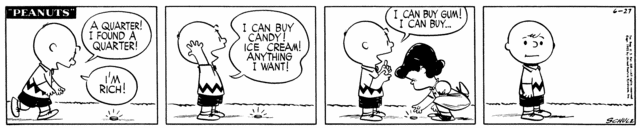
He who hesitates is lost.  You do not know what the future holds.  Pick up the quarter.  learn much from other’s experience.  Realize that today, right this minute, as you are reading these words, you can say “yes” to Jesus and His grace.

Do not harden your hearts to these words…

faster, faster, faster

via Quicken

Ask those who know me really well, and they will confirm for you, I’ve never been a very patient person.  My kids learned their driving habits from me, so I’ve no one to blame but myself when they drive too fast.  I used to drive really fast, and loose, and a little on the edge.  I’m older and wiser now, but occasionally I’ll still need to lighten up on the accelerator, if you know what I mean.  This lack of patience sometimes leaks over into other aspects of my past, present, and future.

I was so in a hurry to get through college, so that I could go on to Seminary.  I knew I was headed there, so why focus on the now, when where I really want to be is there.  In Seminary I was always in a hurry to get through each semester, so I could graduate, and get on with being a Pastor.  Unfortunate circumstances (translation life-interruptus) caused there to be a 20 year hiatus on finishing that degree.  I spent most of that 20 years in the computer industry as a career, and serving my ministry desires through lay-ministry in the church we attended at the time.

When I finally got the opportunity to go into ministry full time, and later finish my Master of Divinity education, then a Doctor of Ministry degree, I pursued each of these with the same vigor and lack of patience as before.  I’ve been a driven person most of my life, always trying to go faster, faster, faster.  I wasn’t trying to run ahead of God, so much as I just wanted to get there faster.

It reminds me a little of the disciples wanting Jesus to quit taking so much time setting up His earthly kingdom.  They asked him after the resurrection, “Lord, is it at this time You are restoring the kingdom to Israel?”  [Acts 2:6]  They were wanting to get there faster.  The reply from Jesus is something we should really focus on here, “It is not for you to know times or epochs which the Father has fixed by His own authority;“[Acts 2:7]  Part of the problem with having this “faster” mentality is thinking God is just a slow-poke.  But Jesus helps them (and us) understand that it isn’t just “kingdom” things that God has fixed in time, but that each minute of our lives is accounted for under God’s sovereign authority.  God saw me before I was born.  He knows the number of my days.  Don’t take my word for it, look at Psalm 139:16 – “Your eyes saw me when I was formless; all my days were written in Your book and planned before a single one of them began.

Today, most days, because we think God is a slow-poke, we become impatient about life, always wishing we could get “there” (wherever there is) faster, faster, faster.  In fact it’s easy to get all wrapped up in “end of days” mentality, wishing God would get it all over with already, so we can all go be with Him in heaven.  Trust me when I say, God isn’t even “nearly” through saving people yet!  Peter tells us, “The Lord is not slow about His promise, as some count slowness, but is patient toward you, not wishing for any to perish but for all to come to repentance.”  [2 Peter 3:9]  God isn’t about to end human history until all the humans who will be saved… are saved.  God’s will is that all come to repentance.

So if you’re one of those who likes to see timelines and deadlines in the Book of Revelation, then let me offer you a small bit of advice.  Slow down.  Read the book, and study the book differently.  It isn’t all about judgment and just getting to heaven.  It is about God saving people who will say “yes” to His grace, even in the worst seven-year period of human history… the end of days.  I can help you with this, if you’d like.  Click to read more.  BOOK

“I am”

via Center

This journey I’m on, writing everyday, using the “Daily Post” as a vehicle to jumpstart my mind, has been at times exhausting, and at other times exhilarating. Some days I have a host of people who read, like and follow what I’ve written.  Other days, I’m lucky to have a handful.  Life is like that isn’t it?  In the now famous words of Bubba Gump’s momma, “Life is like a box of chocolates. You never know what you’re gonna get.”  I always liked this line in the movie because it reminded me of my own mom, she just loved chocolate covered cherries. That bit-sized morsel of chocolate so delicious made even sweeter with the juicy richness of the cherry in the center.  My mother loved them, would eat them by the box;  me – not so much.

chocolate-covered-cheries

Last week I made a treat for desert one night which turned out to be a real hit among some friends at church.  German Chocolate Carmel Bars have been a favorite of mine for a long time.  My new hobby/pass-time for the last 8 months or so has been learning to cook.  While I’m quite sure I’ll never be a “chef” by any stretch of the imagination, I do ok from time to time.  We’re still alive.  So, I decided to make these chocolate bars I have always liked.  Essentially it is a chocolate brownie type treat with caramel and chocolate chips at the center of every bite.  I had a great time making it, and several friends kindly affirmed my burgeoning interest in my new hobby.

german-chocolate-caramel-bars

These images reflect how wonderful my life is today, and the true message I wish to convey through this blog.  Parts of my life these days are like a confectioner’s chocolate, smooth, rich, and tasty.  Other parts of my life are more like the baked chocolate bar, a little crusty and harder on the outside than inside, because of the time spent under the heat of pressure.  Both are treats, and both are made sweeter still by what is on the inside, at the center.  The essence of the chocolate is made sweeter still by the cherries or the caramel, and so my life is enriched by what is at the core of my existence: Jesus.

When Moses wanted to know God’s name, God simply said, “I Am.”  The Creator of the Universe is the center of all life, all knowledge, or any other created thing.  According to John the apostle [John 1:3], “All things came into being through Him, and apart from Him nothing came into being that has come into being.”  Jesus is the center of all things.  According to the apostle Paul [Colossians 1:16] “For by Him all things were created, both in the heavens and on earth, visible and invisible, whether thrones or dominions or rulers or authorities– all things have been created through Him and for Him.”  Jesus is the center of all things.

When we discover this simple truth, we come closer to understanding what brings the sweet richness of life which God always intended for us to experience.  When someone asks you, “What is at the center of your life?”, how do you answer?  Go ahead, ask me at what is at the center of my life.  “I Am.”  Not me – the ornery, cantankerous, sometimes obstinate Dr. Wilkins.  THE – I AM – the Creator, the one who designed me, to be but a reflection of His glory.  I am here to experience God’s grace every day, and to extend His glory to the ends of the earth.  I can only do that when “I AM” is at the center of my existence.

What is at the center of your life?


Jello

via Jiggle

My uncle Wylie was a funny man.  My memories of him are somewhat questionable according to my sisters.  They don’t remember him quite the way I do.  I may have mentioned him in previous articles.  One of my favorite memories is being at his house when the phone would ring, he would grab it up, and say, “ummm… Jello!”  Cracked me up every time.  I think he did it just for me.

jello
(Jello TV ad circa 1960)

Jello was a staple at the Wilkins home.  My favorite of course was either purple or green. Grapes and Limes.  I don’t know why, it just was.  I liked how the Jello squished in my mouth.  Mom said Jello was good for you all the time.  When my own kids were growing up their mother would make Jello Jigglers, because that was the “in” thing at the time. Jigglers are easy to make, just use your favorite cutter and make Jello shapes the kids love to eat. My favorite part was eating the left overs from the cutouts, the shapeless throw aways, the fringes and edges.

Sometimes it seems to me we have a “Jello Jiggler” approach to studying the Bible.  People love to cut out Psalm 23, Luke 2, Jeremiah 29, John 3, and Romans 8, shake them up and watch them wiggle and waggle as our favorites to study and digest.  Sure there are lots of favorite stories, pet stories, pastors love to teach about.  But what about the cutouts?  What about all the left overs that no one really wants to eat?  Are they too dry?  Do they not wiggle enough?  They don’t have that delightful little jiggle? Are they so hard to understand that most of God’s children just avoid them altogether?

Yes.  And there is one book of the Bible in particular that draws very little attention, in fact is avoided most of the time… the Book of Revelation.  If God didn’t want us to read it, study it, learn from it, or eat it like Jello, then why is it there?  There are letters to the church in this book, dictated personally from Jesus.  There are miracles and wonders describing the glory and majesty of God.  There are promises and explanations of why we are here, our very existence is explained in detail, and purpose!  No other Book in the Bible gives us the glimpse of our future home, that is found in Revelation.  The promise of Christ’s return is described and guaranteed in the Book of Revelation!  There is plenty of shake, joggle, waggle, wiggle, fidget, squirm, quiver, tremble, and jiggle in Revelation.

Is it always easy to understand?  Nope.  Is it worth trying?  Yep.  I offer you the opportunity to go on a journey few have been willing to make.  Travel with me into the rough edged, cutout, loose ends of the Jello in the Bible … that is Revelation.  It is a tasty treat!


Very Funny

via Arid

Apparently the type of humor I really enjoy is not dry, it’s absolutely arid.  Don’t ask me to tell a joke, no one can survive that desert. Let me give you a few examples of the jokes that make me hee-haw.  Ready?

I totally understand how batteries feel because I’m rarely ever included in things either.

It’s hard to explain puns to kleptomaniacs because they always take things literally.

I used to think the brain was the most important organ. Then I thought, look what’s telling me that.

The midget fortune teller who kills his customers is a small medium at large.

A farmer in the field with his cows counted 196 of them, but when he rounded them up he had 200.

What does a nosey pepper do?  Get jalapeño business.”

[All jokes courtesy of Christopher Hudspeth]

Often when I would be preaching or teaching and tell one of these type jokes, I might here a snicker or two, one particular lady got my humor almost every time.  But for the majority of my listeners, most would kind of cock their heads, like a dog does when its owner talks baby talk to it.  Occasionally, a few minutes later someone would start laughing quietly, and I knew they finally got it.  I know a few pastors who can’t preach a single sermon without several jokes planted somewhere to keep their audience listening to the lesson.

jesus-laughing

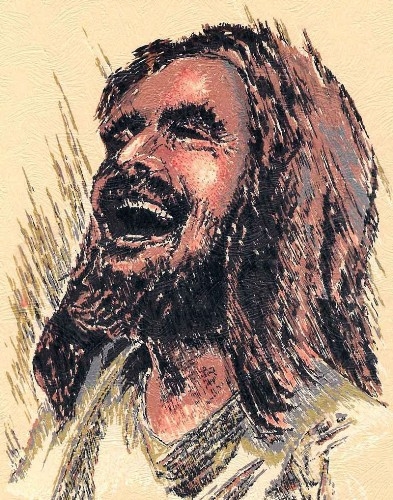
What about Jesus?  Was He funny?  Did He laugh?  Are there actual examples we can draw from in the Bible?  Yes, Jesus was hysterically funny, but like the arid jokes above, sometimes he had to point it out later to His disciples.  For example, think about the name He gave Simon Peter.  Jesus called him, “the rock.”  Which is ironic and humorous all at the same time, since this fisherman vacillated back and forth between trusting the Master, and wanting to do it his own way, usually comically failing in the process.

Here’s another few examples.  His encounters with the Pharisees are just loaded with one-liners Jesus tossed their way to poke fun, hidden in a truth.  You might have to think a little about these.  “Then render to Caesar the things that are Caesar’s; and to God the things that are God’s.” [Matthew 22:21 -irony]  “Let them alone; they are blind guides of the blind. And if a blind man guides a blind man, both will fall into a pit.” [Matthew 15:14 – slap stick] “You blind guides, who strain out a gnat and swallow a camel!” [Matthew 23:24 – juxtaposition]  There’s more but you get the point.

Humor is an integral part of the human condition, there is a reason for laughing as much as there is for crying, and what it does cathartically in our souls.  Don’t be one of those people who live barren-dry humorless lives, always taking life so seriously, and making those around you miserable.  Laugh a little.  Jesus did.


Baby

via Baby

What an interesting word prompt from the Daily Post!  A person with a certain bent could go so many different ways with this word.  Mother’s could write about newborns, Pro-Life and Pro-choice people could write about viability, or when life begins. Anyone (like me) who is tired of the continual alt-left rhetoric about Trump not being their president, might write about how the democratic party is acting like big babies.  People in love could write about “baby” as their favorite pet name for their lover.  Or, someone like me who is the proud grandfather of an almost one-year-old grandson, might write about a grand-baby.  Here’s an interesting fact about babies.  Did you know that a baby’s eyeballs do not grow?  The eyeballs are fully formed and the baby’s head grows to allow more of the whites than the irises to show over time.

baby-eyes

Of course, I’m going off in another direction.  My particular bent always seems to have a biblical point, and why should this one be different, right?  When I saw this word today I almost immediately went to Bethlehem in my mind.  We’re almost two full months past the Christmas season, and for most people, with Valentine’s Day behind us, all eyes are on Saint Patrick’s Day.  Too many people spend a few weeks in December thinking about angels, shepherds, kings and Baby Jesus, then it’s football playoffs, new year’s celebrations, and super bowl parties.  We like to celebrate, and often.  And hey, birthdays are celebrated every day of the year by someone.

Babies are mysterious to me. I want to know what they are thinking when those huge eyes look me, full in the face, with curiosity.  It’s hard for me to side with the pro-choice folks, and not just because of the highly charged political battles, and not just because of the spiritual issues, but because I’ve looked into the eyes of my own children at birth, and now my grandson’s eyes as he is still not yet a year old.  In these moments, I have often thought about the mystery that is salvation, brought to us in a baby, born in Bethlehem.

This baby was destined to grow up, travel to Jerusalem around bar mitzvah time and confound the spiritual leaders of the nation of Israel, then become a carpenter like his earth-daddy.  Not one peep was heard after this until Jesus shows up in Cana at a wedding, and began His earthly ministry.  After three years of wondering around as an itinerant preacher/teacher, he is arrested for blasphemy, tortured then crucified by the Roman army, and put to rest in a borrowed tomb.  That is quite a narrative.  Many today still think it is a mythical story perpetrated on mankind by a bunch of loser disciples.

My question is, “How do you look into a baby’s eyes, and not believe in a Creator?”  God’s infinite wisdom and mercy and grace allow us, if we will, to come to Him in faith, and declare that He is this very Creator.  However, it’s important to understand, in our human minds we can never fathom how God the Creator, could give His only baby boy, to offer us this grace.  I don’t understand it, I cannot comprehend it, the mystery is too great.  Yet it’s true.  It is only when I stepped over the line of faith in the FACT of it, that I too began to feel reborn, a new baby, in Christ Jesus.


The dissonant slur

via Slur

It’s not easy for those losing their hearing to admit this truth. When you raise the level of your voice so the hearing-challenged can understand your words, they pretend something different and shout “you don’t have to yell.”  They don’t even know they’re yelling, because they can’t hear. They live in a Charlie Brown world where most of the conversation, sounded more like, “blah blah, blah blah wa aw wa blah.”  The slurred sound of someone’s voice makes no sense, they can’t distinguish the notes, and it’s frustrating.

blah-blah

Charlie Brown represents a time period for me.  There was a time in high school and college when I could not get enough.  I knew what was coming and I still laughed my head off every time Lucy pulls the football away.  Aaugh!  In college I also spent a lot of my time reading The Gospel According to Peanuts, written by a Presbyterian minister, Robert L. Short. Sometimes when I speak, or write, my impression is that my hearers or listeners are hearing the “blah blah, blah blah wa aw wa blah” rather than the actual thoughts and words I’m communicating.  No amount of wishful thinking on my part can change this it seems.  So just for today, allow the art of a brilliant man named Schultz to help you grasp what my articles are really about.

peanuts1

This world is not getting better, I’m sorry to break it to you this way.  This world is full of darkness and evil, and we hold onto the rhetoric of peace in the middle east, the solving of medical disease, the concept of freedom of the press, because these ideals are not easy to let go.  The Word of God is very clear about what is coming in the near or distant future.  Yet we cling, like Linus to his blanket, to almost anything that will bring us personal peace about who we are, and where we are headed.

It’s just easier for some people, to not be so serious all the time.  Maybe that’s why I identify so strongly with Charlie Brown.  He was always so serious, and naive all at the same time, that’s the story of my life.

Today, I’m hopeful for a bright and glorious future.  Not because the world is getting better, or mankind is evolving to a higher plane, or because we’re on the verge of overcoming racism, violence, plague and pestilence.  When I hear this stuff, I hear”blah blah, blah blah wa aw wa blah.”  I’m hopeful today because I’m closer than I’ve ever been in my life to seeing Jesus.  My hope is Jesus.  Paul taught Titus there is no other.

Titus 2:11-14
For the grace of God has appeared, bringing salvation to all men, instructing us to deny ungodliness and worldly desires and to live sensibly, righteously and godly in the present age, looking for the blessed hope and the appearing of the glory of our great God and Savior, Christ Jesus, who gave Himself for us to redeem us from every lawless deed, and to purify for Himself a people for His own possession, zealous for good deeds.


Heartbeat

via Rhythmic

heartbeat

In the spring of 2005, while going about my chores, I became aware of a heavy pressure in my chest, as though I was pinned to the earth by a giant boulder; I could hardly breathe.  Anyone reading is quickly aware that I did in fact have a heart attack.  Albeit a minor one, tell someone in the middle of a minor heart attack that it’s “minor,” and see how they respond.  I, like so many other men at 50 years old, thought the pain would subside and I would go on with my day.  Not quite.  With every rhythmic beat of my heart the pain seemed to grow in intensity, until I had to sit down.  My brain finally kicked in and I asked myself, “could this be a heart attack?”

Naturally, being a man, my first instinct was to investigate, so I went to the “googles” and typed “Heart Attack Symptoms,” and began to read the checklist.  By the time I got halfway through the list, the pain was growing, so I went to my teenage daughters bedroom and said, “I think I need to go to the hospital.”  She was just learning to drive, and only had her learner’s permit, and said, “I can’t drive you to the hospital!”  Of course I simply responded with, “that’s ok, I”ll drive, let’s go.”  Did it ever occur to me to dial 911, not so much, duh.  So, I drove to the hospital.

Upon arriving at the ER, a woman at reception asked how she could help, I simply said, “I think I’m having a heart attack.”  To which she responded, “Sit down now! We’ll come get you.”  Moments later I was on a bed, strapped with wire to a couple different machines, someone shoved a nitroglycerin pill under my tongue, and off we went to discover what was going on inside my chest.  Here’s where the “minor” part comes in.   While the cardiologist, the attending physician, and all the nurses and aids believed I was having a problem, nothing was registering on the machines to indicate I was in immediate danger.  That said, they weren’t quite ready to send me home.

It took almost 15 hours for the blood work to come back with the enzyme evidence indicating that I did in fact have a heart attack.  The next morning through an angiogram the cardiologist discovered blockages in the lower arteries feeding my heart, and put in two stints.  As it turns out, I had a genetic cholesterol issue, which is now completely controlled with medications.  It was just a minor heart attack, meaning no damage, and I’m still healthy as the proverbial horse.  The result of the whole episode however, changed the rhythmic beat of my life.  I had to slow down.  This my friends was not easy for me to do.

Over the next couple of days my cognitive functions seemed to work overtime processing exactly what had happened to me.  I came face-to-face with the reality or my mortality, and pondered the inevitability of death.  During those sometimes dark hours, I also re-examined my foundational beliefs.  One narrative from Mark’s gospel came back to me time after time, bringing me peace.  As the story goes, Jesus had been teaching about the “the sower and the soils,” and “the mustard seed,” in Mark 4, concluding the day by telling the disciples they were all going to the other side of the Sea of Galilee by boat.

That night a storm arose, so fierce, these seasoned, trained fishermen believed with all their hearts they were about to die.  All the while, Jesus was sound asleep in the stern of the boat.  The dialogue of life is pretty telling here.  The men woke Jesus and asked, “Teacher, do you not care that we are perishing?”  Rather than answer them, Jesus stands up in the boat and says to the wind and the sea, “Hush, be still.”  The narrative teaches us that even the wind and the sea obey His commands.  Then Jesus says, “Why are you afraid?  Do you still have no faith?”  [Mark 4:35-41]

When the rhythmic cadence of your life is upended, when you think you may be dying, when the emotional pain or physical exhaustion almost wins the battle for your existence, listen for the voice of Jesus telling them all, “Hush! Be still!”  The Creator of the Universe is in Sovereign control of all things, events, or circumstances of your life.  Yield to His presence, and do not be afraid.  He will never leave you nor forsake you.  He has promised it to be true.

David’s Song

via Hideout

Every soldier needs a hideout, a secret place to go and not be found by his enemies.  When we think of King David, more often than not our minds turn to his heroic display of courage against the nine-foot tall giant named Goliath.  Or we think of Paul, standing in the synagogue of Psidian Antioch, teaching Hebrew history, and the story David.  Paul said:

Acts 13:22
After He had removed him (king Saul), He raised up David to be their king, concerning whom He also testified and said, “I HAVE FOUND DAVID the son of Jesse, A MAN AFTER MY HEART, who will do all My will.”

Thousands of years before hand when King Saul was only 30 years old, the king assumed God’s will, made a battle-preparation sacrifice since Samuel the priest/prophet was late to the party, and went on to war.  Because of this, Samuel speaks for God in 1 Samuel 13:13-14:

You have acted foolishly; you have not kept the commandment of the LORD your God, which He commanded you, for now the LORD would have established your kingdom over Israel forever. But now your kingdom shall not endure. The LORD has sought out for Himself a man after His own heart, and the LORD has appointed him as ruler over His people, because you have not kept what the LORD commanded you.

Until he became king, David hid in caves, on mountain tops, and low valleys, because he knew all the good places to hide.  He was after all a shepherd well versed in the protection of his herd from thieves or wild animals.  What is so interesting about David is his consistent reliance on God to provide all that he needed.  Psalm 23 is perhaps one of the most sacred and memorized passages in the whole Bible describing God’s provision.

David however, was also a man of war. Most people don’t understand this.  He was a king/soldier, as well as the shepherd boy.  2 Samuel 21 documents this pretty well.  This passage also leads to a wonderfully descriptive song which David spoke the day Jehovah the Lord delivered him from his enemies and King Saul.  Listen to just the first phrases and see if it doesn’t lead you to go read the whole thing.

2 Samuel 22:2-4
The LORD is my rock and my fortress and my deliverer; My God, my rock, in whom I take refuge, My shield and the horn of my salvation, my stronghold and my refuge; My savior, You save me from violence.  I call upon the LORD, who is worthy to be praised, and I am saved from my enemies.”

David’s hideout was God.  David described Him as Jehovah Roi – The Lord is my shepherd: Psalm 23:1.  God provided David all he needed, a place to sleep safely, water, guidance, comfort, anointing oil, a future home, and the promise of dwelling together in perpetuity with his Lord.  God was David’s hideout.

Where, or in whom, do you hide yourself for safety from your enemies?


The Glittering Life

via Daily Post Glitter

The simple definition: to shine with a bright, shimmering, reflected light.  From sequins on a dress, to crystal that dances in the dark radiance of the moon, the origin of the shimmering light is neither the sequin or the crystal.  From a child’s artwork filled with glitter, to the ballroom dancer’s gown, the light shining brilliant and arresting is only reflected from these elements.

There are no sources of reflected light streaming in my office this morning.  It’s overcast, and although the sun is shining on the world, it isn’t in my little office, or out in my yard, or anywhere else I can see with the naked eye.  This doesn’t prove the sun isn’t shining, it just means I can’t see it through the filter of the clouds.  Life is like that sometimes.  I wouldn’t describe this as a dark day, nor would I say it’s gloomy, although that comes closer.  It just is what it is; overcast.

It’s as though The Creator just covered this part of my personal world with a curtain which allowed light to pass through and bring sight, but not beaming in full force, or being reflected off of every shiny surface.  My mind races with the symbolic inferences of my daily life.  Jesus said, [John 8:12] “”I am the Light of the world; he who follows Me will not walk in the darkness, but will have the Light of life.”  Then Matthew records another time when Jesus said, [Matthew 5:14] “You are the light of the world. A city set on a hill cannot be hidden.”

Jesus is The LIGHT, we are the glitter.  I know this because He also went on to say [Matthew 5:16]” Let your light shine before men in such a way that they may see your good works, and glorify your Father who is in heaven.”  The Dr. Jim version of Jesus’ statement is: “Reflect My light through what you do in a way that God get’s the praise.”  We do this best when we comprehend, then live in the understanding, that we are not the original source of the light we reflect.  When God found us, we were a lump of coal.  When God delivers us from the darkness, we become multifaceted diamonds designed to reflect the Glory of God’s radiance.

So does your life glitter this way?  What about days when the sky is overcast, spiritually?  When you’ve had a late night, it’s a little difficult to get out of bed, it’s a Monday and all that work is still waiting for you?  When storm clouds roll in and it gets really dark, is there enough Son still shining into your life, that you glitter, shine and sparkle God’s love and light to everyone around?

According to Jesus, that’s why we’re here.

sparklecross


An Indistinct Shape

via Daily Post: Blur

If only we could see through the smears and stains of life which obscure our perspectives of past, present, and future, then we might have an opportunity to make sense of the shape and form of reality and truth.  The blur often takes place in the question, “Why me?”  Not that the question isn’t valid, because I to have asked it often in my own life.  Validity notwithstanding, it’s the blur causing us to ask the question, so it’s the blur we need to get through.  We seek clarity, understanding, some logical sense of purpose for whatever is causing our eyes to blur.

Sometimes it’s a log.  This common mistake is common among every human ever born. It’s described for us clearly.  Hear the words of Jesus for understanding.

Luke 6:42
Or how can you say to your brother, ‘Brother, let me take out the speck that is in your eye,’ when you yourself do not see the log that is in your own eye? You hypocrite, first take the log out of your own eye, and then you will see clearly to take out the speck that is in your brother’s eye.

Hypocrite is not a “church” word, although it’s often been designated as such.  Hupokrites (Greek) means “actor.”  This definition perfectly describes someone who thinks they know how to fix their neighbors blurred vision, while acting as though they can see perfectly.  Just look around at the political system of the United States government in action for the last 18 months for a grandiose example of hypocrite.

Still, sometimes it’s pain, loss or suffering.  We love to be entertained by the Hollywood moguls who give us great lines of sacrificial pain or death.  Circa 1982 in the Wrath of Khan, Spock says, “Logic clearly dictates that the needs of the many outweigh the needs of the few.” Kirk answers, “Because the needs of the one outweigh the needs of the few.”  Our heart strings pull as Spock dies to save the Starship Enterprise.

Our minds are blurred by our own pain or suffering so we ask, “Why me?”  It’s another common mistake, common to every human. Even the Apostle Paul asked God to take away his pain, three separate times according to Paul’s own blurred memory…our equivalent of “why me?”  Listen to Paul’s witness about what happened next…

2 Corinthians 12:9-10
And He (GOD) has said to me (PAUL), “My grace is sufficient for you, for power is perfected in weakness.” Most gladly, therefore, I will rather boast about my weaknesses, so that the power of Christ may dwell in me. Therefore I am well content with weaknesses, with insults, with distresses, with persecutions, with difficulties, for Christ’s sake; for when I am weak, then I am strong.

Apparently, it was through the acceptance of God’s sovereign hand on Paul’s life, that Paul was able to get past the blur and see the reality, logic, and purpose for his pain, suffering and loss.  To what end?  Well, Paul gives us that information too.  2 Corinthians 1:3-11 is a lengthy description of Paul’s afflictions.  Listen to the message of verses 3-4.

2 Corinthians 1:3-4
Blessed be the God and Father of our Lord Jesus Christ, the Father of mercies and God of all comfort, who comforts us in all our affliction so that we will be able to comfort those who are in any affliction with the comfort with which we ourselves are comforted by God.

All too often we are so blurred in our thinking due to our pain, suffering or loss, that we become paralyzed into thinking or believing we are the only ones hurting this way.  Paul admonishes us to see through the haze, and recognize a greater purpose for our personal relationships with friends and family.  They hurt too.  They experience pain, suffering, and loss too.  In the same way God gives us strength through our own misery, He wants to use us to bring soothing comfort to others our life touches.

Have you ever considered that when you reach out to touch, comfort or soothe someone else’s pain, suffering or loss… even if you haven’t healed completely yet… that this is when the blur fades away and your vision clears, and your pain decreases?  This is by design.  The Creator made us this way on purpose.  He is the God of all comfort.  His great desire is to use us to bring comfort to others.

Blurred vision or crystal clear sight more often than not is a personal choice.


It’s all Greek to me

via Daily Post: Translate

Imagine living for three years with someone where you slept just feet apart; ate every meal together, walked everywhere you went, as your group of 13 traveled from Galilee to Judea and back again.  Imagine seeing the leader of your group doing miracles, hearing Him calling your name personally to follow Him, and knowing the miracles He performed clearly authenticated the claim He made of Himself to be the Promised One, the Anointed, the Messiah.  Imagine living this way among a people who’s culture was being ripped apart by Roman occupation and law.  Listening daily to the words of your leader, it would have been an easy leap of faith to want this powerful man to be the new King of Israel, and remove the pagan laws from your land.  So they did.  To a man, each of the disciples Jesus hand-picked, believed not in the pie-in-the-sky kingdom far into the future, but in an imminent establishing of a new nation of Israel in Jerusalem.  Jerusalem after all was the city of God.

Now imagine each of these men watching their leader being dragged off in chains.  Imagine their confusion for Judas kissing Jesus on the cheek in the Garden of Gethsemane, being taken by the Temple Guard, and hauled off for a mock trial in the middle of the night.  Having spent all those long hours with their Rabboni (Great Master), the huge storm clouds of doubt and despair descend on the group of 11.  Judas has gone and hung himself for his misguided attempts at forcing Jesus to act immediately.  Jesus is being taken to Caiaphas, Peter’s stands by a fire trying to get warm, John finds Mary and tries to offer comfort, and everyone else scatters, thinking they could be next.

We have no context for this life, or for even beginning to think we understand the nature of their confusion demonstrated by their actions.  You and I are not challenged today in these ways, and it was a road to be traveled by only 12 hand-picked men anyway.

So, what’s the point?  The narrative I’m trying to paint for you is one that has a few key elements.

First, when they chose to follow Him, the faith in Jesus these men exhibited is one of complete abandonment of any previous life-choices.  This would be the very definition of the Greek word κύριος (koo’-ree-os) translation: Lord or Master.  Today our closest English variation might be “Sir.”  These men forsook everything to follow Jesus; family, friends, businesses, life stability, just to sit at Jesus feet and listen to Him teach.

Second, Jesus continually was surrounded by thousands of people in crowds, all gathered as word spread of His teaching, and miracle-working ministry.  At one point, looking at the masses of people, Jesus said, “Why do you call Me, ‘Lord, Lord,’ and do not do what I say?” [Luke 6:46]  If the 12 men who were hand-picked didn’t understand half of what Jesus said and did, after all the time they spent with Him privately, what’s to cause us to believe those on the fringes, hearing Him only one or two times, could even partly comprehend His message, purpose or intentions?

Third, we can only have context for the meaning of the word “LORD” if we step back and stop laying our 21st century interpretations on a 1st century document (the Bible).  Here’s a verse we like to quote:

Philippians 2:9-11
For this reason also, God highly exalted Him, and bestowed on Him the name which is above every name, so that at the name of Jesus EVERY KNEE WILL BOW, of those who are in heaven and on earth and under the earth, and that every tongue will confess that Jesus Christ is Lord, to the glory of God the Father.

What’s the reason?  See, that’s the real question.  What is the actual reason every knee bows, or every tongue confesses that Jesus Christ is Lord?  We do such an injustice when we translate these scriptures in 21st century contexts.

The REASON that Jesus is LORD is because:

Philippians 2:5-8
Have this attitude in yourselves which was also in Christ Jesus, who, although He existed in the form of God, did not regard equality with God a thing to be grasped, but emptied Himself, taking the form of a bond-servant, and being made in the likeness of men. Being found in appearance as a man, He humbled Himself by becoming obedient to the point of death, even death on a cross.

Obedience is the best and clearest example of why Jesus is Lord.  Even to the point of death, even death on a cross.

The LAST point of my narrative is, until we see Lordship as something more than occasional church attendance, sporadic giving to ministry or charity, or passing out water at the 4th of July parade… we have completely lost the message in translation.  Jesus is Lord not because I “make” Him Lord of my life.   Jesus IS Lord.  My only choice is to serve Him or not.  My choice is to completely vacate my preconceptions of what it means to serve Him, and follow His Spirit leading me into uncharted waters.  Jesus is Lord whether I see Him walking on water or not.  My obedience, to His command of my life, will be the only determining factor for the world to see … He is my Lord.

Let me try to translate for you one more time… you can hear it if you will…

Why do you call Me, ‘Lord, Lord,’ and do not do what I say?

Peaches

via Juicy

Living in Texas has its benefits, especially if you like your fruits – juicy.  When I was growing up in West Texas I looked forward to spring and summer because we had peach trees in our backyard.  There’s nothing better than walking about 10 paces out the door to a tree so loaded with fruit, we had to use 2 x 4 braces to hold up the limbs.  The whole tree wasn’t more than about 12-15 tall, but it was easily 25+ feet across and bearing a boatload of juicy peaches.  As a young boy I had to hold the fruit with both hands, because they were as big as my daddy’s fist.  Other families around us had plumbs, and some had apricots.  My mother put fruit in our freezer that lasted us through the winter every year.  What great memories.

peaches

Another favorite was cantaloupe.  One of my strong memories from childhood is stopping at a fruit stand outside of Odessa, then watching my mom and dad pick out a large paper bag stuffed with 8-10 cantaloupes about the size of a good dodgeball.  My mouth watered the whole 20 miles back to our house.  Mom would slice up and trim 2-3 cantaloupes in a bowl and chill them for our supper.  Finally at supper she would have to limit my intake, because that’s all I would eat!  The fruit was so juicy and fresh, it would run down my face onto my shirt, and everybody laughed.  Fun times.

God’s Word says the “fruit” of God’s Spirit is JUICY!  In fact, it has so much juice it is evidenced in a person of faith in at least 9 different ways.
Galatians 5:22-25
But the fruit of the Spirit is love, joy, peace, patience, kindness, goodness, faithfulness, gentleness, self-control; against such things there is no law. Now those who belong to Christ Jesus have crucified the flesh with its passions and desires.  If we live by the Spirit, let us also walk by the Spirit.
So my question becomes, “Just how juicy is your life in Christ?”  If Jesus really is the center of our being, the juiciest part of who we are, shouldn’t our inward and outward appearance reflect God’s glory?  Is your life filled to abundance in Christ through His own Holy Spirit?
John 10:10
I came that they may have life, and have it abundantly.
What does your Spiritual fruit look like… is it Juicy?
fruit-of-the-spirit

Squatting in the House of God

via Daily Prompt: Squat

The church building – the structure itself – is often called the house of God.  Traditionally it has been thought of as a sacred place, where God’s Spirit dwells.  That concept comes out of ancient Hebrew culture, where in the Tabernacle in the Old Testament, and the Temple in the Old & New Testaments, both were constructed with an inner chamber called the Holy of Holies, the place where God’s Spirit was present on earth.  As a man came to worship in the Temple, Jewish law stated that every man should pay a tribute for the service of the Temple with a Jewish coin known as a “shekel.” [Exodus 30:11-16]

By the time of the first century, many Jewish people scattered all over the Roman world in the Middle East no longer used Jewish coins or money.  They worked, lived, and were paid in Roman currency.  It became a matter of necessity (convenience?) to have a place where sojourners to Jerusalem could change their money from Roman to Temple currency.  The outer courtyard of the Temple was called the Courtyard of the Gentiles, and was actually more or less a thoroughfare from the Eastern Gate of Jerusalem connecting a passageway to the city on the West.  In this courtyard the money-changers would provide their services for a “fee” the “exchange rate.”  During the Passover week when almost one million Jewish natives would come to Jerusalem to celebrate their heritage, changing money was a profitable business, which led to fraud and corruption at the highest levels of the priesthood.

jesus-cleanses-the-temple

Money is one thing, but these leaders extorted the Jewish people in another way.  Again, according to Jewish Law [Leviticus 14:22], two doves or pigeons were required as a sacrifice.  Most travelers didn’t bring these birds with them on their distant journey, deciding to simply purchase the offerings at the Temple on their arrival.  The sacrifice brokers would set up shop and have plenty of animals, but at outrageous prices, extorting God’s people for profit.  There were merchants selling cattle and sheep as well, all at exorbitant costs.

Enter Jesus.  There are two specific recorded times when Jesus cleansed the Temple: John 2:13-22, and Matthew 21:12-13.  The first time was right after His first miracle at a wedding feast in Cana.  The second time was after His triumphant entrance into Jerusalem beginning the week of Passover, just before His arrest and crucifixion.  The description of the cleansing process employed is much more detailed in the first account.  Jesus observed, then acted.  He made a “scourge of cords” and whipped the merchants into shape, overturning tables of coins, and commanding those selling animals, “Take these things away; stop making My Father’s house a place of business.

In many places across our land today, church has become big business.  Recently I’ve seen coffee bars, bookstores, and money raising plans out the wazoo.  I’ve listened to different church leaders talk about money in ways that make me wonder who’s kingdom they are really trying to build.  It feels like “squatters” in the Temple all over again, and it makes me wonder what Jesus would do if He visited these places.  Would He lash out like in the Temple and say, “My house shall be called a house of prayer; but you are making it a robber’s den,”?

How do we return to the intended purpose of making a journey to God’s house?  Perhaps by entering in the spirit of prayer, by not going through the motions of tradition, by not succumbing to the temptations to turn our places of worship into temples of enterprise.

We need to quit being squatters in the House of God.  We need to return to the heart of worship.

The silence in my head

via Sound

soundofsilence

Simon & Garfunkel’s song was pounding in my headache as I awakened today. “Hello darkness, my old friend… I’ve come to talk with you again…”  Recorded in 1964 by Columbia Studios in New York City, I was only 10 years old when I heard this song on my sister’s radio.  Half a century later, clear as crystal these lyrics sang back to me from my subconscious sleep, over and over and over.  Now I need a nap, to get some rest.

Actually, I’ve had a great deal of experience with silence.  For years as a pastor, whole periods of my daily existence were completely void of sound.  While I would read, study, and write sermons and Bible studies, even the clock made no noice, it was digital. Occasionally I would hear a squirrel run across the roof, or the sound of thunder during a rainstorm, the wind howling through the leaky windows.  Mainly though, the silence was deafening.

It wasn’t that I couldn’t have called someone on the phone.  Yet there it sat, inches away, making no sound.  I could have listened to music, turned on a playlist, the radio, something.  The sound of silence had truly become comfortable for me.  During those hours of quiet contemplation and communion with God, He instilled in my mind during these times of silence, thoughts I would write then later speak.  Even now, as I write these words, the click-click-clicking of the keyboard is as loud as the framer’s hammer driving 3 inch nails into the house being built down the street.  It’s silent in my office, and I hear the cars rushing by on the street as their drivers stream toward work and school while I sit silently listening.

Last line of “The sound of silence” goes like this:

And the people bowed and prayed
To the neon god they made
And the sign flashed out its warning
In the words that it was forming
And the sign said “The words of the prophets
Are written on the subway walls
And tenement halls
And whispered in the sounds of silence

The cryptic language of the song is a fascinating study in the power of lyrics and music. A neon light, thousands of people talking without speaking, hearing without listening, writing songs that no one hears, because they are never shared… these are very powerful images, but what does it all mean?  Simon said in an interview with NPR, “It wasn’t something that I was experiencing at some deep, profound level – nobody’s listening to me, nobody’s listening to anyone – it was a post-adolescent angst, but it had some level of truth to it and it resonated with millions of people. Largely because it had a simple and singable melody.”  So there you go, just a song that resonated with millions of people, because of the music and lyrics.

David the King of Israel wrote music and lyrics thousands of years ago, which people still sing.  We don’t really know what the music sounded like, so much as we know the lyrics today.  Although Amy Grant helped us all with “Thy Word is a lamp unto my feet and a light unto my path,” [Psalm 119:105] and other music artists along the way have captured the Psalms in their music,  I wonder if there was music accompaniment at all to some of the things David wrote.  For example, “Shout joyfully to the LORD, all the earth; Break forth and sing for joy and sing praises.” [NASB] many people my age recognize as “Make a joyful noise unto the LORD, all the earth: make a loud noise, and rejoice, and sing praise.” [KJV] Psalm 98:4

During my hours of study there would be times of joy and shouting, and times of weeping and silence.  In all those hours I remember fondly God’s voice “whispering in the sounds of silence.”

Be still, and know that I am God!   Psalm 46:10a


Believe

via Expectation

fairway

Does expectation shape the result? Often one’s expectations only reflect the hope of something different than reality.  When I stand on the first tee box, driver in hand, I expect to hit a perfect drive down the middle of the fairway, somewhere between 250-275 yards away.  On any given day, and any given golf course, this expectation may or may not happen at all.  Other days, 12 out of 14 times I’ve accomplished the middle part, or the fairway part, or the distance part… but not necessarily all at the same time.

In Oscar Wilde’s essay The Decay of Lying, he said, “Life imitates art far more often than Art imitates life.”  It’s a philosophical argument where Wilde suggests that what is discovered through life or nature is not what is really there, but only what artists have taught us to find there – through art.  As you can imagine, I have difficulty with this philosophy.  Do I really need some artist to describe for me the glory of God’s world, or my relationship to it?  I don’t think so.  When I smell the freshly mown grass, when I feel the sand in my eyes after hitting out of the bunker, when the sun shines directly in my eyes as I stare eastward into the dawn on that short par 3, artists generally cannot improve on what I experience in those moments.  God created me with the capabilities through my five senses, and through the cognitive processes of my brain, and the willful choices of my soul, to recognize and give Him glory for the stunning beauty of nature and life.  It’s not just my philosophy, it is absolute truth, according to God’s Word.

Romans 1:20-23
For since the creation of the world His invisible attributes, His eternal power and divine nature, have been clearly seen, being understood through what has been made, so that they are without excuse.  For even though they knew God, they did not honor Him as God or give thanks, but they became futile in their speculations, and their foolish heart was darkened.  Professing to be wise, they became fools, and exchanged the glory of the incorruptible God for an image in the form of corruptible man and of birds and four-footed animals and crawling creatures.

Obviously I  use the golf model as my illustrative point because I truly enjoy playing the game.  It affords me the opportunity to be out of my office and enjoy God’s world of nature in a way that is satisfying to me.  According to Wilde, I would never know the grass was green or just mown, know the grain of sand was in my eye, or how brightly the sun was shining if some artist didn’t clue me into these experiences.  Doesn’t that sound just ridiculous to you?

Here’s another example.  A  high school student’s artwork depicting police officers as pigs gets taken down, and that draws attention to the prevailing attitude among many in the black community toward the police officers in this country.  But did this high school artist help us comprehend this reality?  No, it has been clearly seen by anyone with their eyes even half open.  It has been this way for a really long time.

John the Apostle could be considered an artist in one sense.  In the final book of the Bible which he authored, John uses dramatic imagery that is often mysterious to us today because we have no context for what the imagery means.  His illustrations come from a Hebrew mindset, in a late first-century world, dominated by Roman authority, all while John is in exile on an island called Patmos.  Do your relate to these conditions in any way? The whole book is filled with visions and narratives that chill us with their apocalyptic finality.  Yet, if we focus only on the imagery, we lose the message of the book.  For it is not a book meant to bring fear, but hope and expectation.

The Book of Revelation is divinely designed to reveal the true nature and character of Jesus Christ as God.  Within this basic belief is this simple truth:  The whole Book of Revelation is about the extravagant love of God, and the exorbitant lengths and measures taken by God to allow all who will, to come to salvation through Jesus.

When we approach understanding Revelation with the expectation that God wants us to understand it, then we can, in the proper context.  The context is the hope found in Christ alone.  In Christ alone I place my trust.  Keith Getty and Stuart Townend wrote a wonderful new hymn of praise capturing the essence of “expectation”, which I leave with you today:

In Christ alone my hope is found
He is my light my strength my song
This Cornerstone this solid Ground
Firm through the fiercest drought and storm
What heights of love what depths of peace
When fears are stilled when strivings cease
My Comforter my All in All
Here in the love of Christ I stand

In Christ alone who took on flesh
Fullness of God in helpless babe
This gift of love and righteousness
Scorned by the ones He came to save
Till on that cross as Jesus died
The wrath of God was satisfied
For every sin on Him was laid
Here in the death of Christ I live

There in the ground His body lay
Light of the world by darkness slain
Then bursting forth in glorious Day
Up from the grave He rose again
And as He stands in victory
Sin’s curse has lost its grip on me
For I am His and He is mine
Bought with the precious blood of Christ

No guilt in life no fear in death
This is the power of Christ in me
From life’s first cry to final breath
Jesus commands my destiny
No power of hell no scheme of man
Can ever pluck me from His hand
Till He returns or calls me home
Here in the power of Christ I’ll stand

Keith Getty | Stuart Townend
© 2001 Thankyou Music (Admin. by Capitol CMG Publishing)

Danger Zone

via Seriousness

the-seriousness

The feeble attempts being made today to minimize, trivialize, make light of, or outright dismiss the seriousness of the spiritual sins of our country goes beyond the pale.  Wow, now that’s one somber statement huh?  Yes it is; it’s what I’m known for I guess.  People who know me, really see me and get me, recognize these initial thoughts as pretty standard stuff from me.  That’s because they also know that for most of my life, I’ve been more serious than silly, more earnest than carefree, and more passionate than apathetic.  It’s in my DNA for some reason.  While I’ve tried really hard in the last couple of years to realize all the seriousness can at times get in the way of clear communication, I seem to live in the danger zone of being misunderstood constantly.

I’ve looked at ways to try to stem the tide of my serious nature.  Yet, just by viewing some quotes on the internet to adjust one’s attitude, rather than becoming soothed  or adjusted, I was in some ways saddened, becoming even more serious. Here are just a few of the quotes I found:

Learn to laugh. Seriousness is a sin, and it is a disease. Laughter has tremendous beauty, a lightness.  It will bring lightness to you, and it will give you wings to fly.” – OSHO

Concern yourself with not what is right, and what is wrong, but with what is important.” – LIFEQUOTESRU.COM

Seriousness is the only refuge of the shallow.” – Oscar Wilde

You know my name, not my story.  You’ve heard what I’ve done, not what I’ve been through.” – QuotesGram

It’s this last quote that really caught my attention today.  This turn of phrase allowed me to conceptualize why people find me so serious-natured all the time.  Most pastors would fall into the category of “public figure,” even if they never pastored large or mega-large churches.  This is because their lives are constantly under the microscope of public (translated: congregational) opinion (translated: judgment). Having lived under this microscope for most of my life, the seriousness of my role dictated my conduct, speech, and actions… even when it was contrary to what I really wanted to say or do.  My seriousness resulted in people asking “Are you ok, you don’t look well?”  Actually, what they saw in my facial expression was not feeling ill, but concentrating so hard on what I was about to teach or preach, that my seriousness was perceived as illness.

Anyone who really knows me would never say that I was “shallow.”  Many would say, “Dr. Wilkins, why do you go on… and on… and on…” when I become seriously passionate about the importance of trusting in God’s Word instead of man’s opinions.  I laugh a lot. I’m a pretty goofy person actually, but not many people see me this way.  Not because I don’t want them to, but because they only see me when I am in the role of Pastor/Teacher.  They do not know any other me, most I believe don’t want to.

What the last two years has taught me, is to recognize “seriousness” can be a danger zone. A topic of discussion, relationship issues, interpersonal communications, emotional and psychological implications, physical responses and reactions, can all be effected by the earnest, sober-minded, DNA-hardwired approach I’ve inhabited for so long.  So lighten up already.  Chillax.  Choose your moments wisely Dr. Wilkins.  Take some of your own medicine.  Didn’t you say God’s Word teaches us: “there is a time… to weep and a time to laugh, a time to mourn and a time to dance.”  [Ecclesiastes 3:4]

Why yes, I did.  Thanks for reminding me. [By the way, I’m smiling right now.]


Laodicea

via Lukewarm

Laodicea was located on a plateau several hundred feet high, making the city easily fortified, but vulnerable in another way.  Located in a valley but up on a plateau, the city had no natural springs or sources of water at the top.  Consequently, the city had to pipe in the water from miles away, using an elaborate aqueduct system, and this water system was vulnerable to attacking forces.  Antiochus II established the city, naming it for his first wife, establishing the town’s founding date as sometime before 253 B.C., since by this time he had divorced her.

There was a large Jewish contingent in the valley’s three cities, which led the local governor to issue a decree to stop them sending the temple taxes to Jerusalem.  Of course the committed families tried to send it anyway, but this tax shipment was confiscated. From the amount of gold confiscated by the Roman government, scholars have determined that around 7,500 Jewish men lived in Laodicea at the time.  Which means that several thousand more women and children would have lived there also.  At the time of peace in the Roman Empire, these families prospered as the city grew and prospered.

The city served as an important commercial center, banking center and industrial center. It was so rich in fact, that when ruined by an earthquake in 60 A.D., the city used its own resources to rebuild; it needed no additional assistance from Rome.  The most famous product coming out of Laodicea at the time was soft, black wool.  This wool, extremely valuable and sought after, was used in clothes, carpets, and for many other products. Another important aspect of the city’s wealth came from medicine.  In Laodicea an eye-salve was discovered that the city then exported all over the Greco-Roman world.  These three aspects of the city – finance, wool, and eye salve -are seen clearly in what Jesus has to say to this church.

Revelation 3:14-22 is a letter from Jesus to the church in Laodicea.  We look back at this ancient document and wonder if it could really hold some information which applies to our lives today.  The clear answer for those who want to find it is, yes.  The church of Laodicea looks so similar to many churches today, and many scholars have said so.  Consider this quote from John R. W. Stott:

Perhaps none of the seven letters is more appropriate to the twentieth-century church than this. It describes vividly the respectable, sentimental, nominal, skin-deep religiosity which is so widespread among us today. Our Christianity is flabby and anemic. We appear to have taken a lukewarm bath of religion.

In fact it was this church’s lukewarm condition that led Jesus to say:

Revelation 3:16
So because you are lukewarm, and neither hot nor cold, I will spit you out of My mouth.

In this letter, Jesus is calling lost people to step over the line of  faith, the weak in faith to become zealous in their convictions, and the lukewarm to become committed through repentance.  The point of Revelation 3:16 is not to bring condemnation, but to stimulate the church to return to Jesus in faith and service.  It is restorative, not judgmental.  It is a second chance, or maybe a third.  That’s why the spitting out part is not the last thing Jesus says to this church.  He also says:

Revelation 3:20
Behold, I stand at the door and knock; if anyone hears My voice and opens the door, I will come in to him and will dine with him, and he with Me.

If anyone… is the operative phrase here.  Jesus excludes no one from His grace.  Jesus will reject no one who comes in faith.  Jesus is all-inclusive to those who return to Him, or having rejected Him come in repentance for their lack of faith.  For the church today, for people of faith all over the world, this letter to Laodicea ends with an applicable truth.

Revelation 3:22
He who has an ear, let him hear what the Spirit says to the churches.

Un-Aware

via Aware

According to the Urban Dictionary, “Ignorance is Bliss” is a term used to falsely justify apathy on the given subject in the form of a catchy cliche.  Example: Seat belts are to be worn while driving a motor vehicle in Texas. If an officer of the law stops you to ask why you aren’t wearing your seat belt, don’t answer “I didn’t know I had to.”  Ignorance of the law, is not immunization from the law.  And by the way, every passenger in the vehicle must also be buckled up… don’t be caught unaware.

Today, after examining FaceBook, it seems to me that we should expand the meaning to include any attitude used by the liberal media, iconic celebrities, Facebook post writer, or Twitter-bird who screams incorrect information, to falsely justify their hate.  They are blissfully ignorant of just how wrong they are; they are unaware and don’t seem to care.

It’s an easy trap to fall into because most of us live in such small circles of influence, and this earth is a great big world.  I would venture to say that less than 1% of FaceBook writers even know what Trump’s travel ban document really stated, because they haven’t read it.  To have an opinion on a matter so grave as this would necessarily dictate, that a person do some research on the topic, don’t you think?  Yet, the constant spin-doctored dribble from the “unaware” social media, is like a festering sore oozing green-grey slime, seeking out someone to infect with this particular version of social cancer.  For example, a simple search on my browser this morning yielded the EXACT language used, showing the WHOLE executive order as submitted by the White House.

(https://www.nytimes.com/2017/01/27/us/politics/refugee-muslim-executive-order-trump.html?_r=0)

Perhaps we should return to a Three-Wise-Monkey attitude.  See wisely, hear wisely, and speak wisely.  The Three-Wise-Monkeys came to us from Japan, where they have been widely known since the 17th century.  While there are many possible meanings, the exact meaning lost in the passing years, there is something we should gain here.   The monkey’s gestures suggest that we “see no evil, hear no evil, and speak no evil.”  A wise “monkey” person is one who is prudent in what they look at, listen to, or what they say.  The wise person considers the consequences (awareness of each having consequences), then makes sensible decisions with the awareness that if he or she does not know what to do, they ask another “monkey” person for advice.

3monkeys

Awareness, or consciousness, is what distinguishes us as a human.  That a monkey should have to teach us how to act is rather insulting at the least.  Humanity has traveled down a long dark path away from what we were created to know deep inside our DNA.  Right and wrong go all the way back to the beginning, with Adam and Eve choosing to use the “but we didn’t know” excuse with God.  The problem is, both Adam and Eve, and God, knew this wasn’t true.  They saw evil, they heard evil, and they spoke (said yes) to evil.  They were not wise in these actions.  They pretended to be unaware of the consequences of their actions, but in this they lied even to themselves.

Ok.  Time to wrap it all up.  First, every person’s actions have consequences.  Being blissfully ignorant of this fact, will not impede the person’s accountability in the matter. Second, when we continue to only see the “evil” in other people, instead of the “good,” we unwisely tend to lash out in ways that are in themselves evil.  Third, this in no way brings glory to the God who created us to know better.  It’s time we employ the “one another” rule given to us in God’s Word.

Ephesians 4:32
Be kind to one another, tender-hearted, forgiving each other, just as God in Christ also has forgiven you.

1 Thessalonians 5:11
Therefore encourage one another and build up one another, just as you also are doing.

Ephesians 4:2
with all humility and gentleness, with patience, showing tolerance for one another in love,

John 13:34
A new commandment I give to you, that you love one another, even as I have loved you, that you also love one another.